
Tim, I misread the portion of the article referring to the female that Harry Smith got from Bill Green. I see that Del says she was of "french Gascogne" descent. I understand your reasoning that she could have been a GGS instead of GBdG. Del did say "Grand Bleu de Gascogne descent" elsewhere in the article, but he wasn't speaking specifically of the Green Mountain hounds. Makes much more sense to me now.lmorgan wrote:But if that is the case, then why does Del clearly say that both the Smith and Green hounds were of Bleu Gascognne descent?
Bill Green's breeding advisor
-
lmorgan
- Tight Mouth

- Posts: 133
- Joined: Sun Dec 07, 2008 6:10 pm
- Facebook ID: 0
- Location: SE Louisiana
Bill Green's breeding advisor
Larry Morgan
Morgan's Cajun Blue Gascons
Morgan's Cajun Blue Gascons

-
Brady Davis
- Open Mouth

- Posts: 936
- Joined: Wed Nov 26, 2008 6:33 pm
- Facebook ID: 0
- Location: Northern Colorado
Re: Bill Green's breeding advisor
liontracker wrote: So if a guy likes that kind of hound, where does he get one today?
I think we have a good idea where to get one

By the way, interesting articles getting posted.....keep them coming.
-
blueticker78
- Silent Mouth

- Posts: 61
- Joined: Sun Jan 18, 2009 1:36 am
- Location: New York
- Location: DeKalb New York
Re: Bill Green's breeding advisor
Just want to add a good point I believe bill did import some hounds and the reason I do is simply because of the characteristics of some of bills hounds in comparison to the ggs and the time frame that the ggs was developed if you do the math someone if not bill had to import these hounds in the early 1900s I like anyone else have no proof of this but if you put two and two together it is there in black and white. Here is another good point the French settlers for years and years brought French hounds of all sorts into this country with no or little written proof there were alot of porcelains hounds imported at one point there was grande bleus not documented every where and at some point there was some obvious ggss imported too. I think that we tend to associate the first documented grande bleus and the two imported in the 70s as the only french blood there is in our hounds of today and that is the farthest from the truth the ozark strain was predomitaly French for quite sometime. I guess time and DNA will tell some hidden mysteries well see.
Josh Walter
-
African

- Bawl Mouth

- Posts: 162
- Joined: Mon Apr 07, 2008 11:33 am
- Location: Limpopo
- Location: South Africa
- Contact:
Re: Bill Green's breeding advisor
If one follows the timeline then it is evident the Gascon-saintongeois would have only been set, in terms of conformation, in the early 20th century.
An extract from a French magazine(1905) describes how some individuals could be both entered into the GGS class or GBG class.
The Saintongeois was a more similar in structure to a greyhound than a bloodhound (St Huberts hound). It was however prized for its nose and employed almost exclusively in the hunting of the western European wolf.
Translated from the French description:
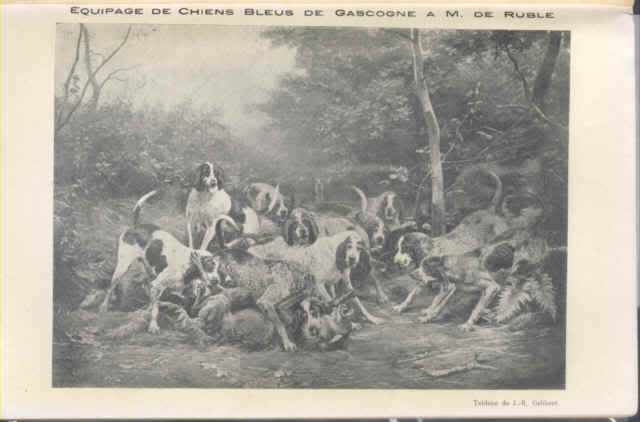
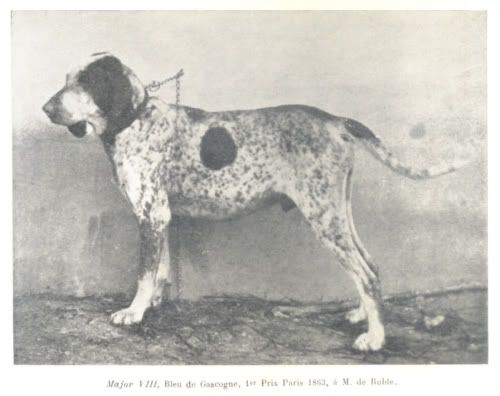
"The Gascon-Saintongeois was created in 1845 by crossing two old French Hounds. After the death of Marquis de la Porte aux Loups his dogs were inherited by Baron de Carayon-Latour. De Carayon-Latour also had Saintongeois from De Saint Legier. De Carayon-Latour wished to restablish the hunt with a pack of hounds. As the Saintongeois were weakened by in-breeding, De Carayon-Latour needed fresh blood. He found that in the Bleus de Gascogne of Baron de Ruble."
"This crossing did not give the reconstruction of the Saintongeois but created a new breed: the Gascon-Saintongeois. The Bleu-blood was too dominant.
Another name of the Gascon-Saintongeois is Chien de Virelade, to the Castle of Virelade where De Carayon-Latour lived."
Both GGS and GBG are evident in this impresssion:
A GBG from Baron de Ruble:
An extract from a French magazine(1905) describes how some individuals could be both entered into the GGS class or GBG class.
The Saintongeois was a more similar in structure to a greyhound than a bloodhound (St Huberts hound). It was however prized for its nose and employed almost exclusively in the hunting of the western European wolf.
Translated from the French description:
"The Gascon-Saintongeois was created in 1845 by crossing two old French Hounds. After the death of Marquis de la Porte aux Loups his dogs were inherited by Baron de Carayon-Latour. De Carayon-Latour also had Saintongeois from De Saint Legier. De Carayon-Latour wished to restablish the hunt with a pack of hounds. As the Saintongeois were weakened by in-breeding, De Carayon-Latour needed fresh blood. He found that in the Bleus de Gascogne of Baron de Ruble."
"This crossing did not give the reconstruction of the Saintongeois but created a new breed: the Gascon-Saintongeois. The Bleu-blood was too dominant.
Another name of the Gascon-Saintongeois is Chien de Virelade, to the Castle of Virelade where De Carayon-Latour lived."
Both GGS and GBG are evident in this impresssion:
A GBG from Baron de Ruble:
-
liontracker
- Babble Mouth

- Posts: 2052
- Joined: Tue Nov 27, 2007 2:49 pm
- Location: CO
- Location: Durango, CO
Re: Bill Green's breeding advisor
Larry, thank you sir. I enjoy a level headed, well thought out debate. On the other hand I hate personal attacks on the computer, they are like being in a straight jacket and beat with a hank of garden hose filled with lead shot.
I do not believe Del ever talked to Bill Green. I do know that he respects Bill's breedings in the highest. As of recently, he doesn't think there is GGS blood in american blueticks. I think all Del's info came from Harry. I also believe that the past bluetick historians are mistaken in believing that all of the great french blood in american blueticks is Grand Bleu de Gascogne. Primarily from the gift of hounds sent to George Washington by the French. Which if memory serves, said document only says "Gascon hounds" or otherwise hounds of gascony, which is a region in france, not GBG. As far as I know, color was never mentioned and pics do not exist. But G.W. got a selection of hounds at that time, including bassets, so why would he have not recieved the best...The Saintongeois in it's pure form not the modern GGS? Also, based on the secrecy and behind the barn goings on concerning past bluetick breedings, why would Bill Green tell anyone, including Harry, his secret formula? Also, Grand Bleu de Gascogne sounds more romantic and is easier to say than Grand Gascon Saintongeois. Typical american corruption of words.
The GGS that Bill had were not just used in his breedings, the Lees used some and Harry Smith, although those were likely part breds as the fullblood GGS stayed in Vermont as broodstock and were never hunted in the SW. Also. when Bill died, where did those GGS of his go to? Ah, behind the barn secrecy again. You can bet they are in some of our hound blood today. Which brings up a point to consider. With all the secret breedings behind the modern biggame hound, how can we be certain what is behind any of them?
In the scientific world, a person first has an idea, then a theory and then it becomes a scientific fact. At first I had an idea, then I developed a theory, I hope soon it will become a proven fact.
Also, someone being picked out of a mugshot line up is considered prima fascie evidence.
Why would not the old Bill Green pics be the same?
Also, Harry Smith said that the Ozark Mountain blood contained a high concentration of old french blood and that is why he bought so many. Everyone considers this to be fact, yet where is the evidence? Pics? Personal Opinion?
I do not believe Del ever talked to Bill Green. I do know that he respects Bill's breedings in the highest. As of recently, he doesn't think there is GGS blood in american blueticks. I think all Del's info came from Harry. I also believe that the past bluetick historians are mistaken in believing that all of the great french blood in american blueticks is Grand Bleu de Gascogne. Primarily from the gift of hounds sent to George Washington by the French. Which if memory serves, said document only says "Gascon hounds" or otherwise hounds of gascony, which is a region in france, not GBG. As far as I know, color was never mentioned and pics do not exist. But G.W. got a selection of hounds at that time, including bassets, so why would he have not recieved the best...The Saintongeois in it's pure form not the modern GGS? Also, based on the secrecy and behind the barn goings on concerning past bluetick breedings, why would Bill Green tell anyone, including Harry, his secret formula? Also, Grand Bleu de Gascogne sounds more romantic and is easier to say than Grand Gascon Saintongeois. Typical american corruption of words.
The GGS that Bill had were not just used in his breedings, the Lees used some and Harry Smith, although those were likely part breds as the fullblood GGS stayed in Vermont as broodstock and were never hunted in the SW. Also. when Bill died, where did those GGS of his go to? Ah, behind the barn secrecy again. You can bet they are in some of our hound blood today. Which brings up a point to consider. With all the secret breedings behind the modern biggame hound, how can we be certain what is behind any of them?
In the scientific world, a person first has an idea, then a theory and then it becomes a scientific fact. At first I had an idea, then I developed a theory, I hope soon it will become a proven fact.
Also, someone being picked out of a mugshot line up is considered prima fascie evidence.
Why would not the old Bill Green pics be the same?
Also, Harry Smith said that the Ozark Mountain blood contained a high concentration of old french blood and that is why he bought so many. Everyone considers this to be fact, yet where is the evidence? Pics? Personal Opinion?
-
Majestic Tree Hound
- Open Mouth
- Posts: 627
- Joined: Mon Jun 25, 2007 2:50 pm
- Location: Virginia
- Location: New Market, Va. - Rochingham Co.
Re: Bill Green's breeding advisor
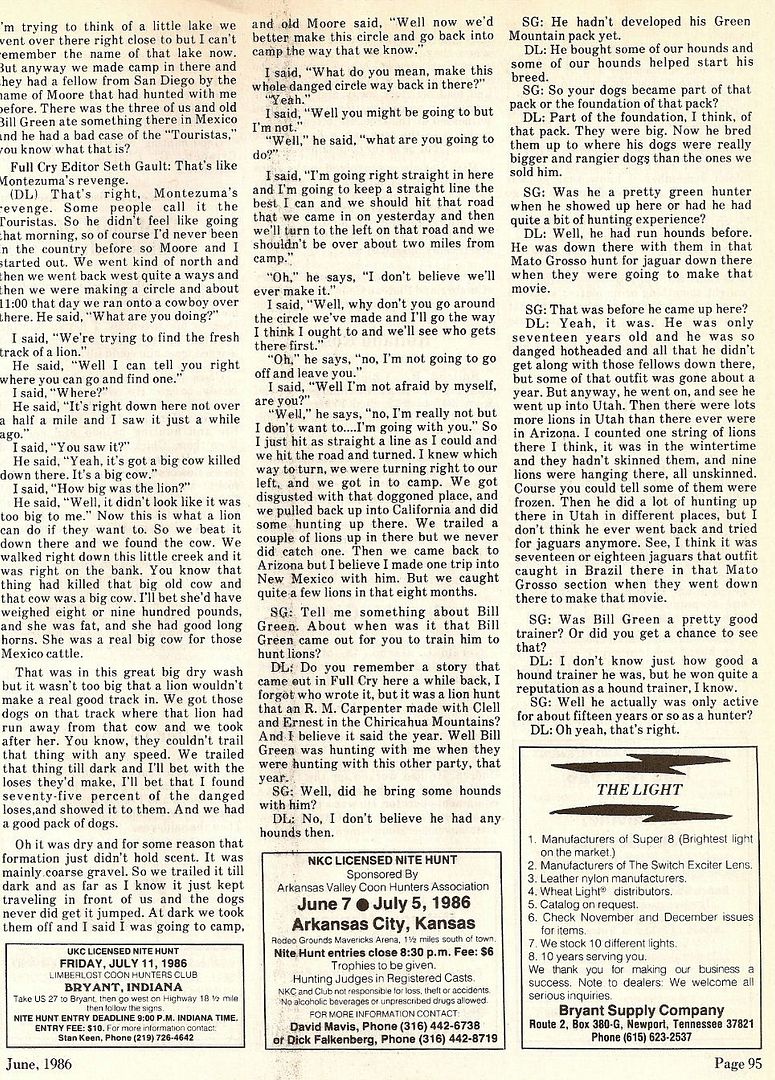
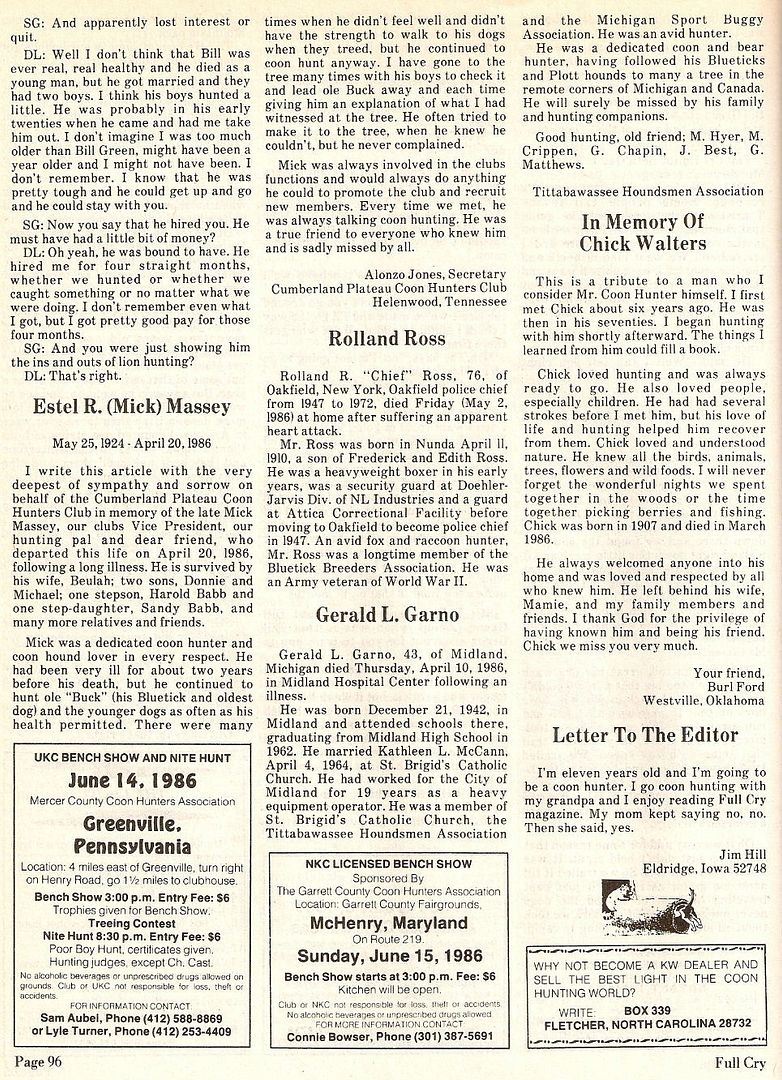
Just another Story thats kinda Interesting was this Interview with Dale Lee about Bill Green..
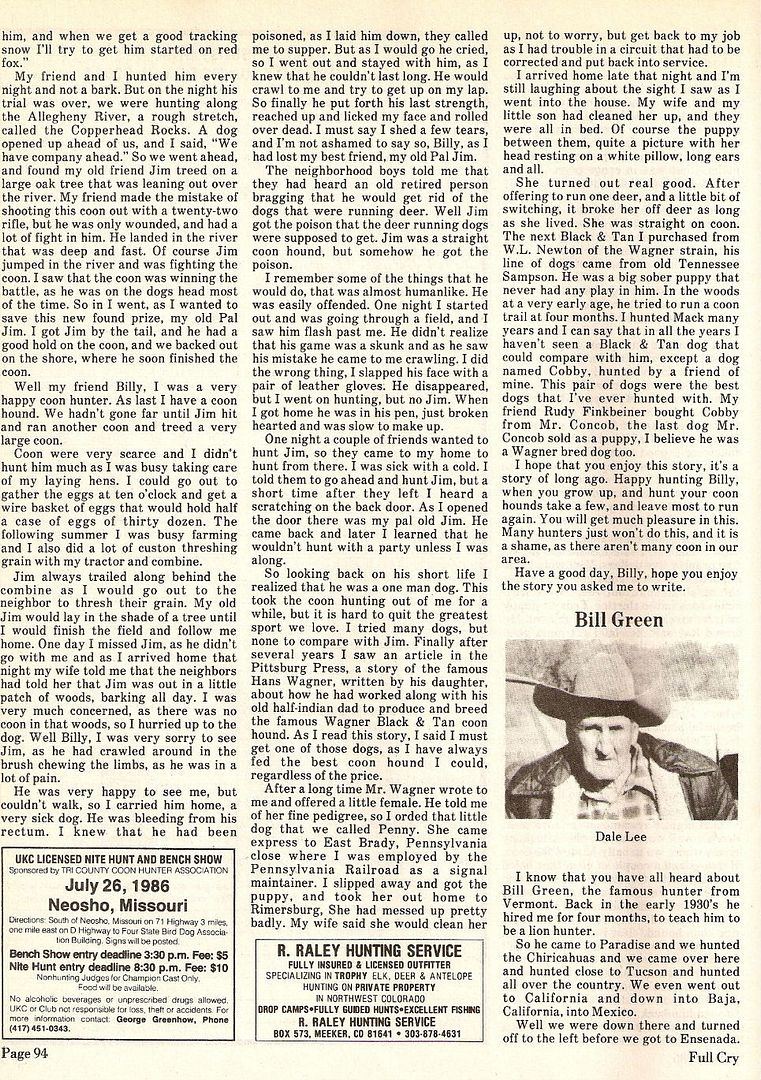
In the Artical it keeps mentioning a "Movie" that was made in South American in which Bill (16-17 years old !! ) was their and this was Prior to Bill Hiring the Lee's and Prior to the Lee's heading to South America to hunt Jag.s ..
Now I have another Artical which Suggest that Bill Returned to South America to Hunt Jags With 4 of His Hounds and After the Lee's 22 Hound Pack was nearly Whiped out by Jags..
Now this is where "I Think" Bill had his Exposure to the French Hounds was in the Hunting Group that were making the "Jag Movie"
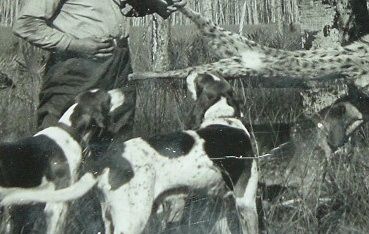
I this Photo these Hounds are French Tri Color Hounds !! Not Running Walkers and Not Treeing Walkers !! I have Enlarged the Profile of these Hounds Heads and Compaired them to the French Tri's .. Under the Spotted Cat is a Redticked Hound ??
Now The Bigest Question I Have that will better Prove Bill's Exposure to the French Hounds would Be "The Movie" ... But I Believe the Movie is Somewhere in Europe in some Fancy Hunt Lodge !!! I have Searched the Internet for over a Year for some Glimps of It .... It could be in German, French, Belgem Or in the English in the UK !!!
The Artical ..
SO the Other Question is Did Bill Buy a GGS From the Fokes Making the "Movie" in South America and Bring it Home with Him when he Returned !! ???
WHERE's THE DAMM MOVIE !!!!!!!!!!!!!!!!
In the Artical it keeps mentioning a "Movie" that was made in South American in which Bill (16-17 years old !! ) was their and this was Prior to Bill Hiring the Lee's and Prior to the Lee's heading to South America to hunt Jag.s ..
Now I have another Artical which Suggest that Bill Returned to South America to Hunt Jags With 4 of His Hounds and After the Lee's 22 Hound Pack was nearly Whiped out by Jags..
Now this is where "I Think" Bill had his Exposure to the French Hounds was in the Hunting Group that were making the "Jag Movie"
I this Photo these Hounds are French Tri Color Hounds !! Not Running Walkers and Not Treeing Walkers !! I have Enlarged the Profile of these Hounds Heads and Compaired them to the French Tri's .. Under the Spotted Cat is a Redticked Hound ??
Now The Bigest Question I Have that will better Prove Bill's Exposure to the French Hounds would Be "The Movie" ... But I Believe the Movie is Somewhere in Europe in some Fancy Hunt Lodge !!! I have Searched the Internet for over a Year for some Glimps of It .... It could be in German, French, Belgem Or in the English in the UK !!!
The Artical ..
SO the Other Question is Did Bill Buy a GGS From the Fokes Making the "Movie" in South America and Bring it Home with Him when he Returned !! ???
WHERE's THE DAMM MOVIE !!!!!!!!!!!!!!!!
Steve Morrow "Saltlick Majestic's"
"Never Have Hounds Or Kids And You Won't Get Your Heart Broke"!!

Salt Lick Kennels
http://home.earthlink.net/~landjmorrow/saltlickkennels/
Bawling Tree Kennels
http://www.bawlingtreekennel.com
Sunrise Outfitting
http://www.sunriseoutfitting.com/
Canine Training Academy - Co.
http://www.caninetrainingacademy.com/
The Mara Conservancy - Kenya Africa
http://www.maratriangle.org/
"Never Have Hounds Or Kids And You Won't Get Your Heart Broke"!!
Salt Lick Kennels
http://home.earthlink.net/~landjmorrow/saltlickkennels/
Bawling Tree Kennels
http://www.bawlingtreekennel.com
Sunrise Outfitting
http://www.sunriseoutfitting.com/
Canine Training Academy - Co.
http://www.caninetrainingacademy.com/
The Mara Conservancy - Kenya Africa
http://www.maratriangle.org/
-
Majestic Tree Hound
- Open Mouth
- Posts: 627
- Joined: Mon Jun 25, 2007 2:50 pm
- Location: Virginia
- Location: New Market, Va. - Rochingham Co.
Re: Bill Green's breeding advisor
Now My Approch to Using the GGS is Slightly Different than Tim's Approch ....
I have read and Studied about the Type of hound that the Lee's had "At The Time Period"
that Bill would have Bought His Hounds from the Lee's ... And "I Admit alot of it is Hear Say from Articals" The Type of Hound that the Lees were Running in or around 1937-1939 .. Was A Cross of Slash Ranch Hound, Bloodhound and a Redtick hound "Named after a Town in Texas" Now this "Redticked Hounds" Org. seam to come from a bunch of "La. Frenchies" Crossing French Hounds !!!!
So I produced a litter Thru Careful Selection of 25% Treeing Walker X 25% English Coonhound X 18% Old Blue Lines X 32% Bloodhound... Using only the Finest lines of Pure Hard hunt Hounds I could Find..
This litter is 5 months old now and are pure Natural hard Cold Nosed, hard Hunting Tree Hounds ... I have 3 pups from the Litter and Others in very good Hands plus 2- with Sheriffs/Police Dept.s in Both Col. and UT.. So this litter is being tested every whichway their could be ..
The Pure French Female I got from Tim is Show me Alot of good Qty's.. And Time will tell if She will be Qty. Breeding material ..
She will be crossed Both on my Main Line and on the Above 4/4 Cross .. Then Testing Will begain Again..
I have read and Studied about the Type of hound that the Lee's had "At The Time Period"
that Bill would have Bought His Hounds from the Lee's ... And "I Admit alot of it is Hear Say from Articals" The Type of Hound that the Lees were Running in or around 1937-1939 .. Was A Cross of Slash Ranch Hound, Bloodhound and a Redtick hound "Named after a Town in Texas" Now this "Redticked Hounds" Org. seam to come from a bunch of "La. Frenchies" Crossing French Hounds !!!!
So I produced a litter Thru Careful Selection of 25% Treeing Walker X 25% English Coonhound X 18% Old Blue Lines X 32% Bloodhound... Using only the Finest lines of Pure Hard hunt Hounds I could Find..
This litter is 5 months old now and are pure Natural hard Cold Nosed, hard Hunting Tree Hounds ... I have 3 pups from the Litter and Others in very good Hands plus 2- with Sheriffs/Police Dept.s in Both Col. and UT.. So this litter is being tested every whichway their could be ..
The Pure French Female I got from Tim is Show me Alot of good Qty's.. And Time will tell if She will be Qty. Breeding material ..
She will be crossed Both on my Main Line and on the Above 4/4 Cross .. Then Testing Will begain Again..
Steve Morrow "Saltlick Majestic's"
"Never Have Hounds Or Kids And You Won't Get Your Heart Broke"!!
Salt Lick Kennels
http://home.earthlink.net/~landjmorrow/saltlickkennels/
Bawling Tree Kennels
http://www.bawlingtreekennel.com
Sunrise Outfitting
http://www.sunriseoutfitting.com/
Canine Training Academy - Co.
http://www.caninetrainingacademy.com/
The Mara Conservancy - Kenya Africa
http://www.maratriangle.org/
"Never Have Hounds Or Kids And You Won't Get Your Heart Broke"!!
Salt Lick Kennels
http://home.earthlink.net/~landjmorrow/saltlickkennels/
Bawling Tree Kennels
http://www.bawlingtreekennel.com
Sunrise Outfitting
http://www.sunriseoutfitting.com/
Canine Training Academy - Co.
http://www.caninetrainingacademy.com/
The Mara Conservancy - Kenya Africa
http://www.maratriangle.org/
Re: Bill Green's breeding advisor
i think the movie that you are talking about is when bil went to the mato grosso. he did not take any hounds with him he was the taxidermist for them. but you will find that he did go back with hound later on. some wher i have old letters on the mato grosso when he went the first time and that was when thay did the film that i now of.i bet that bill is looking down on all this with a BIG smile
-
Majestic Tree Hound
- Open Mouth
- Posts: 627
- Joined: Mon Jun 25, 2007 2:50 pm
- Location: Virginia
- Location: New Market, Va. - Rochingham Co.
Re: Bill Green's breeding advisor
This is what I'am very courius about John is "What and Who was the Film About"Bow wrote:i think the movie that you are talking about is when bil went to the mato grosso. he did not take any hounds with him he was the taxidermist for them. but you will find that he did go back with hound later on. some wher i have old letters on the mato grosso when he went the first time and that was when thay did the film that i now of.i bet that bill is looking down on all this with a BIG smile
And Where is it Now ??
If it was a US production I'am sure it would have Surfaced by now !! Maybe National Geographic may have it in archives ... Eather That or it Was made Overseas ???
Steve Morrow "Saltlick Majestic's"
"Never Have Hounds Or Kids And You Won't Get Your Heart Broke"!!
Salt Lick Kennels
http://home.earthlink.net/~landjmorrow/saltlickkennels/
Bawling Tree Kennels
http://www.bawlingtreekennel.com
Sunrise Outfitting
http://www.sunriseoutfitting.com/
Canine Training Academy - Co.
http://www.caninetrainingacademy.com/
The Mara Conservancy - Kenya Africa
http://www.maratriangle.org/
"Never Have Hounds Or Kids And You Won't Get Your Heart Broke"!!
Salt Lick Kennels
http://home.earthlink.net/~landjmorrow/saltlickkennels/
Bawling Tree Kennels
http://www.bawlingtreekennel.com
Sunrise Outfitting
http://www.sunriseoutfitting.com/
Canine Training Academy - Co.
http://www.caninetrainingacademy.com/
The Mara Conservancy - Kenya Africa
http://www.maratriangle.org/
Re: Bill Green's breeding advisor
i get some time ill see if i can find the letters i have and newspaper clippings on this.
-
liontracker
- Babble Mouth
- Posts: 2052
- Joined: Tue Nov 27, 2007 2:49 pm
- Location: CO
- Location: Durango, CO
Re: Bill Green's breeding advisor
I saw an internet article where they are still using GGS in the motto grosso today on Jags.
Steve do you have the article in which Harry O. Smith tells the names of some of the hounds he bought from Bill?
If Bill is watching all of this, then he needs to throw us a bone or two!LOL
Steve do you have the article in which Harry O. Smith tells the names of some of the hounds he bought from Bill?
If Bill is watching all of this, then he needs to throw us a bone or two!LOL
-
Brady Davis
- Open Mouth
- Posts: 936
- Joined: Wed Nov 26, 2008 6:33 pm
- Facebook ID: 0
- Location: Northern Colorado
Re: Bill Green's breeding advisor
LT, I think I saw that same article about GGS on Jags...I'm gonna look, I have loads of info saved on my laptop....
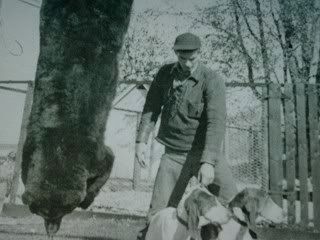
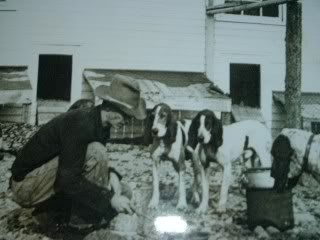
Those couple pics above of Bill sure enough look like HEAVY GGS blood is in them....
Those couple pics above of Bill sure enough look like HEAVY GGS blood is in them....
-
Majestic Tree Hound
- Open Mouth
- Posts: 627
- Joined: Mon Jun 25, 2007 2:50 pm
- Location: Virginia
- Location: New Market, Va. - Rochingham Co.
Re: Bill Green's breeding advisor
Now I just did 2 searches again on the Films and this is one Hit -- Colonel P. H. Fawcett (1936) vanished much like its subject. ... Fawcett himself now embarked on two expeditions into the Matto Grosso, in an .... perhaps inevitably given the perennial nature of the Fawcett story, the book s film
The Hit is a French-- Jaguar. Jean Rouch. producer. Films de la Pléiade and Interama Video Classics. .... Notes on jaguar and puma feeding habits in the Pantanal of Mato Grosso, ...... Nichol, A. A. 1936. Large predator animals. Bulletin of the University of ...
This One to Too Old !!
SA-76.5.1: LAST OF THE BOROROS
1930-1931; 1,200 ft (32 min) silent b&w; film/video;
supplementary materials: 1,2,3,4,6
Edited film shot on an expedition to the Mato Grosso of Brazil.
Film documents various aspects of daily and ceremonial life in
the Bororo village of Bobore on the Paraguay River west of
Cuiaba. The film was made in the course of an ostensive attempt
to rescue British explorer Colonel Percy Fawcett and his son who
disappeared on the Xingu River. Shots of historical and
ethnographic interest include: Aloha Baker meeting with General
Candido Rondon in Rio de Janeiro, rail travel from Sao Paulo to
Corumba, boats landing and the expedition plane taking off and
landing at the Descalvados ranch, a first contact scenario with
Bororo of Bobore village, reception by the chief and male
villagers in front of the baitemannageo (men's house), palaver
and gift-giving through the chief, adornment for ceremonial
dances which includes face and body painting with urucu and
wearing of spectacular headdresses of macaw feathers, food
preparation (women winnowing and pounding grain), Aloha Baker
with a bari (shaman), a sequestered male ceremonial dance
(associated with the dual social and cosmological organization of
Ge-speaking tribes), and two Bororo men experiencing couvade
(sympathetic labor pains).
Creator: Aloha Baker, explorer (1908- )
Here's a 1940 Publication where they Killed a Bunch !!
Crile, G., and D. P. Quiring. 1940. A record of the body weight and certain organ and gland weights of 3690 animals. The Ohio Journal of Science 40:219-259.
176. Crossin,
1936 Writen Gifford, Edward Winslow. 1936. Northeastern and western Yavapai. University of California publications in American archaeology and ethnology volume34, no.4. University of California Press, Berkeley, California, USA
Gezz Their were ALOT of Fokes in that Region around this Time Period !!!!!!
Haltenorth, T. 1937. Die verwandtschaftliche Stellung der Grosskatzen zueinander. II. Zeischrift für Säugetiere 12:97-240.
330. _____. 1936. Die verwandtschaftliche Stellung der Grosskatzen zueinander. I. Beschreibung der Schädelknochen. Zeischrift für Säugetiere 11:32-105.
Pocock, R. I. 1939. The races of jaguar ( Panthera onca). Novitates Zoologicae 41:406-422
The Hit is a French-- Jaguar. Jean Rouch. producer. Films de la Pléiade and Interama Video Classics. .... Notes on jaguar and puma feeding habits in the Pantanal of Mato Grosso, ...... Nichol, A. A. 1936. Large predator animals. Bulletin of the University of ...
This One to Too Old !!
SA-76.5.1: LAST OF THE BOROROS
1930-1931; 1,200 ft (32 min) silent b&w; film/video;
supplementary materials: 1,2,3,4,6
Edited film shot on an expedition to the Mato Grosso of Brazil.
Film documents various aspects of daily and ceremonial life in
the Bororo village of Bobore on the Paraguay River west of
Cuiaba. The film was made in the course of an ostensive attempt
to rescue British explorer Colonel Percy Fawcett and his son who
disappeared on the Xingu River. Shots of historical and
ethnographic interest include: Aloha Baker meeting with General
Candido Rondon in Rio de Janeiro, rail travel from Sao Paulo to
Corumba, boats landing and the expedition plane taking off and
landing at the Descalvados ranch, a first contact scenario with
Bororo of Bobore village, reception by the chief and male
villagers in front of the baitemannageo (men's house), palaver
and gift-giving through the chief, adornment for ceremonial
dances which includes face and body painting with urucu and
wearing of spectacular headdresses of macaw feathers, food
preparation (women winnowing and pounding grain), Aloha Baker
with a bari (shaman), a sequestered male ceremonial dance
(associated with the dual social and cosmological organization of
Ge-speaking tribes), and two Bororo men experiencing couvade
(sympathetic labor pains).
Creator: Aloha Baker, explorer (1908- )
Here's a 1940 Publication where they Killed a Bunch !!
Crile, G., and D. P. Quiring. 1940. A record of the body weight and certain organ and gland weights of 3690 animals. The Ohio Journal of Science 40:219-259.
176. Crossin,
1936 Writen Gifford, Edward Winslow. 1936. Northeastern and western Yavapai. University of California publications in American archaeology and ethnology volume34, no.4. University of California Press, Berkeley, California, USA
Gezz Their were ALOT of Fokes in that Region around this Time Period !!!!!!
Haltenorth, T. 1937. Die verwandtschaftliche Stellung der Grosskatzen zueinander. II. Zeischrift für Säugetiere 12:97-240.
330. _____. 1936. Die verwandtschaftliche Stellung der Grosskatzen zueinander. I. Beschreibung der Schädelknochen. Zeischrift für Säugetiere 11:32-105.
Pocock, R. I. 1939. The races of jaguar ( Panthera onca). Novitates Zoologicae 41:406-422
Steve Morrow "Saltlick Majestic's"
"Never Have Hounds Or Kids And You Won't Get Your Heart Broke"!!
Salt Lick Kennels
http://home.earthlink.net/~landjmorrow/saltlickkennels/
Bawling Tree Kennels
http://www.bawlingtreekennel.com
Sunrise Outfitting
http://www.sunriseoutfitting.com/
Canine Training Academy - Co.
http://www.caninetrainingacademy.com/
The Mara Conservancy - Kenya Africa
http://www.maratriangle.org/
"Never Have Hounds Or Kids And You Won't Get Your Heart Broke"!!
Salt Lick Kennels
http://home.earthlink.net/~landjmorrow/saltlickkennels/
Bawling Tree Kennels
http://www.bawlingtreekennel.com
Sunrise Outfitting
http://www.sunriseoutfitting.com/
Canine Training Academy - Co.
http://www.caninetrainingacademy.com/
The Mara Conservancy - Kenya Africa
http://www.maratriangle.org/
-
Majestic Tree Hound
- Open Mouth
- Posts: 627
- Joined: Mon Jun 25, 2007 2:50 pm
- Location: Virginia
- Location: New Market, Va. - Rochingham Co.
Re: Bill Green's breeding advisor
Tim Look at this one I found !!!!!
Seton, E. T. 1920. The jaguar in Colorado. Journal of Mammalogy 1:241.
Seton, E. T. 1920. The jaguar in Colorado. Journal of Mammalogy 1:241.
Steve Morrow "Saltlick Majestic's"
"Never Have Hounds Or Kids And You Won't Get Your Heart Broke"!!
Salt Lick Kennels
http://home.earthlink.net/~landjmorrow/saltlickkennels/
Bawling Tree Kennels
http://www.bawlingtreekennel.com
Sunrise Outfitting
http://www.sunriseoutfitting.com/
Canine Training Academy - Co.
http://www.caninetrainingacademy.com/
The Mara Conservancy - Kenya Africa
http://www.maratriangle.org/
"Never Have Hounds Or Kids And You Won't Get Your Heart Broke"!!
Salt Lick Kennels
http://home.earthlink.net/~landjmorrow/saltlickkennels/
Bawling Tree Kennels
http://www.bawlingtreekennel.com
Sunrise Outfitting
http://www.sunriseoutfitting.com/
Canine Training Academy - Co.
http://www.caninetrainingacademy.com/
The Mara Conservancy - Kenya Africa
http://www.maratriangle.org/